Abstract
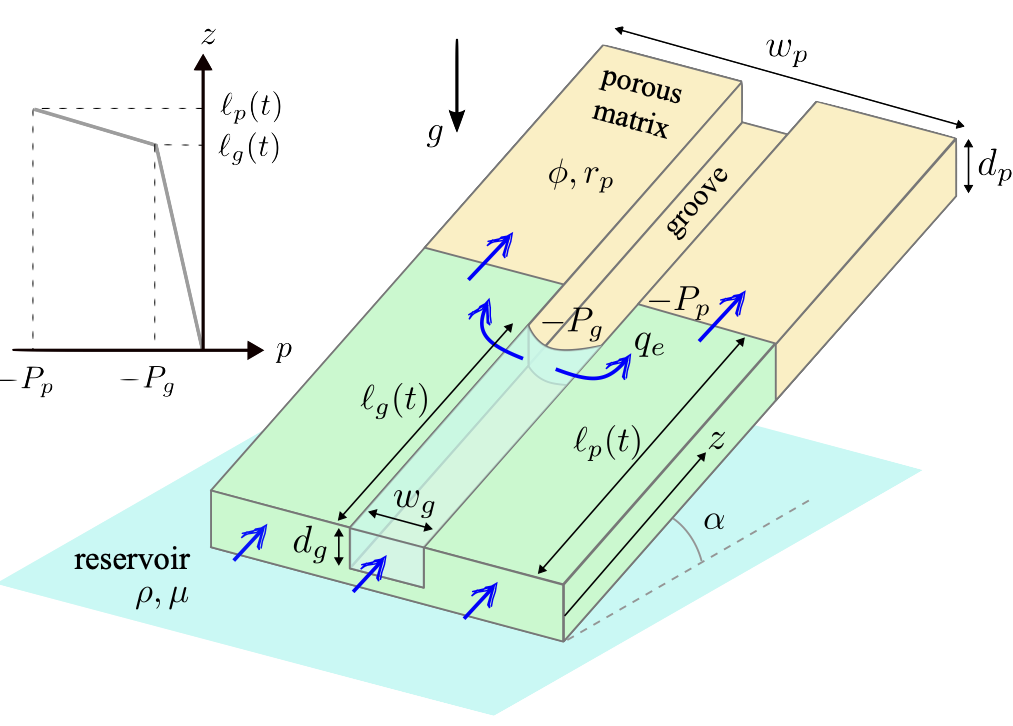
Wicking of fluid in paper-based microfluidic devices can be greatly enhanced by engineering macroscopic grooves into the surface of the paper. We developed a quantitative model of this enhancement by resolving the coupled flow in the paper matrix and the groove. While the groove enhances wicking by providing a low-resistance conduit for flow, we find that the degree of enhancement depends strongly on the poorer wettability of the groove as well as the effect of gravity. We obtain an analytical prediction of imbibed length as a function of time, generalizing the Lucas–Washburn law to microporous wicks with engineered macroscopic surface grooves. The prediction is shown to be in quantitative agreement with previous experiments of upward wicking in both single- and multigrooved paper channels. The model also rationalizes the experimental finding that wide grooves may slow down imbibition despite their larger cross-sectional area and, thus, identifies optimal groove widths.