Abstract
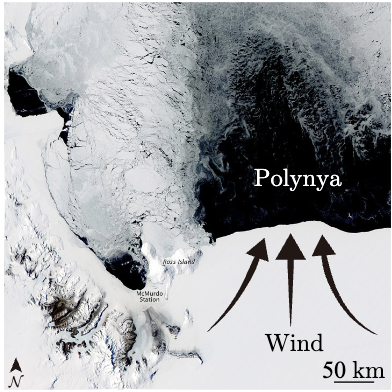
Polynyas—persistent regions of open water within polar sea ice—play a critical role in polar ocean-atmosphere interactions. We combine theoretical modeling and numerical simulations to investigate the dynamics and thermodynamics of wind-driven, latent-heat-generated polynya formation adjacent to straight and curved coastlines. Under the assumption of negligible ice internal pressure, we propose a one-dimensional, continuum, mass- and momentum-conserving theory characterizing the offshore distribution of ice velocity and the spatiotemporal evolution of ice concentration. Finite-element simulations incorporating realistic sea-ice rheology validate the theoretical predictions, demonstrating strong agreement in steady-state polynya widths and ice dynamics. These results align qualitatively with observational climate data. Furthermore, we generalize the framework to two dimensions, enabling quantitative predictions of leeward polynya formation around a model circular island. The proposed theoretical framework advances mechanistic understanding of polynya formation and provides a foundation for improving their representation in climate models.